NSFW AI Art Generator Explained: What It Is and Who It's For
Learn what an NSFW AI art generator is, how it differs from NSFW AI image tools, and who benefits most from stylized adult artwork.
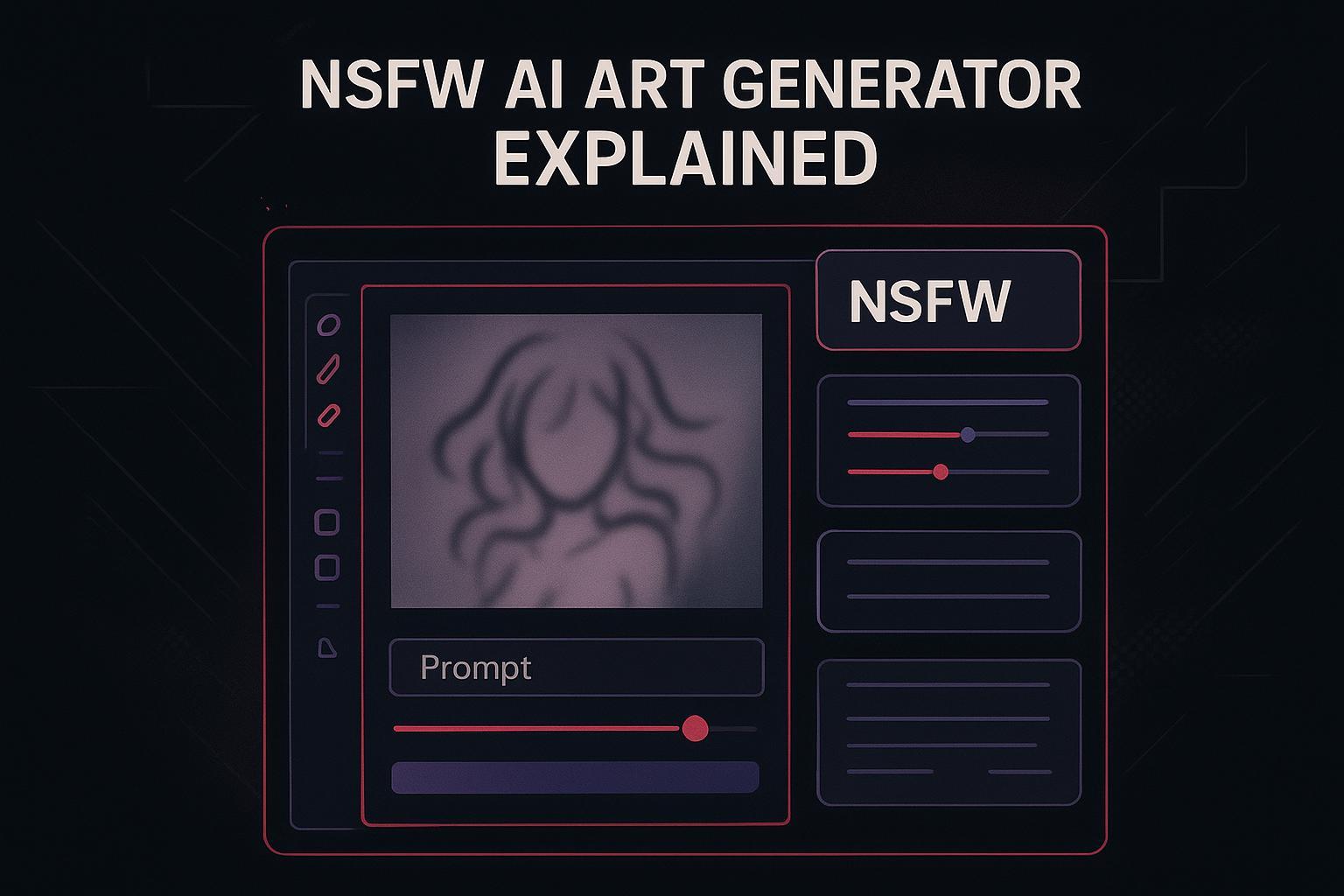
If you’re searching for an NSFW AI art generator, you’re probably not looking for generic “uncensored images.” You’re looking for stylized adult artwork you can actually direct—anime, illustration, painterly looks, and other aesthetics where style, linework, and character design matter as much as the subject.
This guide explains what an NSFW AI art generator is, who it’s for, what it’s not, and how it differs from an “NSFW AI image generator.” It’s written for creators who care about style control and character consistency—without turning into a step-by-step prompt tutorial.
Key Takeaway: An NSFW AI art generator is best thought of as a stylization-first system for adult (18+) artwork—where the core value is controlling an illustration/anime aesthetic, not just getting an uncensored output.
What is an NSFW AI art generator?
An NSFW AI art generator is a text-to-image (and sometimes image-to-image) tool that can produce adult (18+) artwork in an art-forward style—think illustration, anime-inspired rendering, painterly compositions, or other non-photographic aesthetics.
Under the hood, many modern generators are built on diffusion-based image models. If you want a plain-English view of that mechanism—how “noise” gets iteratively refined into an image—SuperAnnotate’s diffusion model overview (2025) is a solid starting point.
What makes “art” distinct here isn’t the existence of NSFW content. It’s that the tool is expected to:
Render a coherent style (linework, shading, color language) instead of drifting toward generic outputs.
Respect art-centric prompt cues (style tags, illustration descriptors, composition intent).
Support consistency workflows (so your character doesn’t look like a different person every generation).
For deeper coverage later in this cluster: pricing and prompt execution are their own topics—this pillar is here to define the category and help you navigate it.
Who is this for (and who it’s not for)?
Search intent matters. People who type “NSFW AI art generator” are usually creators trying to produce stylized adult art—not casual curiosity, not academic exploration.
This is for you if you care about stylized adult artwork
You’re in the right place if you care about:
Anime/illustration aesthetics (including hentai-style art with clearly adult characters)
Style consistency across a set (a “series” feel rather than one-off images)
Prompt expressiveness (you want the generator to understand art-direction language)
Iteration speed with control (refine, vary, lock things down, then push quality)
This is not for you if you want real-person realism or face swaps
A line worth drawing clearly: “NSFW AI art” should not be treated as a pathway to generating non-consensual or real-person sexual content.
If your goal involves:
real people (celebrities, ex-partners, public figures)
face swaps / deepfakes
anything non-consensual
…then the ethical and legal risk isn’t a footnote—it’s the point. This pillar won’t help with those uses.
For deeper coverage in this cluster later: a dedicated safety/ethics piece can go further; here we’ll keep it practical and creator-aligned.
NSFW AI art generator vs NSFW AI image generator: what’s the real difference?
Creators often use “image” and “art” interchangeably in conversation. But for tool selection, the difference is useful:
NSFW AI image generator often implies broader output goals, including more photorealistic or “general purpose” imagery.
NSFW AI art generator implies stylized output—anime/illustration/painterly rendering—where the model (and the workflow) is evaluated on art-direction control, not just uncensored capability.
In other words: art is not just “image, but with different branding.” It’s closer to asking, “Can this system hold an aesthetic?”
If you want the full breakdown (and how to decide which category your project actually belongs in), read: NSFW AI art generator vs NSFW AI image generator.
For adjacent context, see the image-focused pillar: best NSFW AI image generators.
What “stylized” means in practice: the main NSFW AI art style families
“Stylized” isn’t one thing. It’s a spectrum of visual languages, each with different failure modes.
Anime and illustration-style outputs
This is the most common intent behind “NSFW AI art generation tools” searches.
What creators usually want here:
clean linework or illustration-like edges
deliberate facial features and proportions
consistent clothing/accessories and character identifiers
a look that feels “drawn,” not “photographed”
The reason this category often needs specialized models (or a style-aware workflow) is simple: the generator has to learn a specific aesthetic prior, not merely depict a subject. You can see evidence of style-specialized training in model ecosystems like Hugging Face—for example, the anime_illust_diffusion_xl model card describes an anime-illustration tuned diffusion model.
Painterly and fantasy illustration
Some creators want a more “concept art” feel—brushwork, dramatic lighting, storybook rendering.
The control problem shifts here: you may get beautiful compositions, but consistency (especially for a recurring character) can be harder without deliberate constraints.
Semi-realistic “art” (not photo)
A lot of creators want something between anime and realism.
In this zone, you’re often juggling:
how much stylization you’re willing to trade for anatomy coherence
how much detail you want versus how stable you need the face/identity to remain
For deeper coverage later: a dedicated styles guide can map this spectrum with example prompts and checklists—this pillar is just establishing the taxonomy.
What creators should expect: control, consistency, and the trade-offs
An NSFW AI art generator is only as useful as your ability to steer it.
Style control is easier than “identity control”
Most tools can latch onto a style faster than they can lock a character.
That’s why creators talk so much about character consistency—keeping key traits stable across multiple outputs. If you want a deeper dive on that specific problem (and non-NSFW-specific techniques that still apply), see how to keep character consistency in NSFW AI images.
Expect iteration (and plan for it)
Even in stylized workflows, you’re typically doing cycles of:
specify intent (subject + style + composition)
generate variations
keep what works
refine
Some platforms add “edit” style controls. Research and product demos increasingly show diffusion-based editing is an active area; for example, DragonDiffusion on OpenReview (2024) explores controllable manipulation on diffusion models.
“Uncensored” isn’t a quality guarantee
A tool being explicit-capable doesn’t automatically mean it’s good at:
consistent illustration aesthetics
clean anatomy
holding a character across a sequence
And even the opposite is true: a tool can be stylistically excellent but heavily filtered.
For deeper coverage later in the cluster: prompts and pricing are where these trade-offs become concrete.
Responsible use baseline: a creator checklist that keeps you out of trouble
This is a category where “just because you can” is not a useful standard.
Adults-only (18+): treat this as a hard constraint, not a vibe.
Consent is the baseline: do not generate sexual content involving real people or anyone who hasn’t consented.
Avoid real-person deepfakes: harm and abuse risks are not theoretical; they’re documented.
If you want a credible overview of why deepfake sexual content is especially harmful, the American Academy of Pediatrics has a clear explainer in The Impact of Deepfakes, Synthetic Pornography, & Virtual Child… (2025).
And for a “how platforms should think about safety” framing (not creator tactics), Thorn’s Safety by Design for Generative AI (2024) is a useful reference.
One more practical note: safety filters in mainstream generators can be bypassed in some cases; Johns Hopkins researchers discussed this in AI image generators can be tricked into making NSFW content (2023). Don’t outsource your ethical boundary to a refusal message.
For deeper coverage later: a dedicated responsible-use guide can expand this into platform policies, storage/privacy questions, and creator risk reduction.
Where does DeepSpicy fit in this category?
DeepSpicy, an NSFW AI generation platform covering uncensored ai image, NSFW video generator.
At a category level, platforms in this category are typically built to support creator priorities that mainstream generators often struggle with—especially around creative freedom, iteration, and consistency.
If your next question is “where do I control the look and constraints so outputs stay in the lane I want,” start with DeepSpicy's NSFW AI art generator settings here: DeepSpicy's NSFW AI art generator settings.
(Notice what we’re doing: this pillar explains the category; the settings page is where you go when you’re ready to translate intent into configuration.)
FAQ
Is an NSFW AI art generator the same as an NSFW AI image generator?
Not exactly. In creator usage, “art” usually signals stylized output—anime/illustration/painterly—while “image” is often broader and can skew more photorealistic. If you’re choosing tools or planning a workflow, treating them as distinct categories helps.
Does “uncensored” mean the tool will generate anything?
No. “Uncensored” often means “fewer restrictive filters,” but every platform still has constraints—legal, policy, safety, or quality constraints. It’s better to evaluate tools on what they support reliably than on the promise of no limits.
Can I use NSFW AI art tools for real people?
You shouldn’t. Even when it’s technically possible, generating sexual content involving real people (especially without consent) is ethically abusive and can be illegal depending on jurisdiction.
What should I prioritize first: style or character consistency?
If you’re building a “series” or a recurring character, consistency quickly becomes the limiting factor. Start by defining what makes the character recognizable, then add style and composition nuance once the identity holds.
Do I need special prompt formats for stylized NSFW AI art?
Often, yes. Some style-tuned systems respond better to art-direction cues (tags, style descriptors, composition language) than to paragraph prompts.
If you want prompt ideas and patterns (without turning this pillar into a prompt tutorial), you can use this prompt-oriented resource as a starting point: NSFW AI prompts (35 examples).
Next steps for creators
If you’re here because you want stylized adult artwork you can direct, the productive sequence is:
Decide whether your goal is art-stylized or image-realistic (then read the comparison).
Pick a style family (anime/illustration vs painterly vs semi-realistic).
Lock your constraints and iteration habits.
When you’re ready to move from “I understand the category” to “I’m tuning outputs,” you can adjust DeepSpicy's NSFW art generation settings on the NSFW AI Art Generator page (Content Generation Settings section).