Free NSFW AI Video Generator: What You Actually Get Without Paying
A candid look at what “free” actually gets you—clip length, resolution, credits, queues, watermarks, and when paying makes sense.
Key takeaways
“Free” usually means short clips + limited credits + lower priority, not unlimited NSFW video.
The most common caps are seconds per clip, daily quota, and queue time—watermarks are less predictable.
Many mainstream AI video tools refuse explicit prompts by policy, so the “free” you’re seeing may be SFW-only.
If you need longer clips, higher resolution, or predictable throughput, you’re evaluating paid plans as much as models.
What people mean when they search “free nsfw ai video generator”
If you’re searching free nsfw ai video generator, you’re not asking for a lecture on ethics or a pitch.
You want one thing: Can I get usable adult video output without paying—at least enough to decide if this category is worth it? If you’re also comparing what a paid, adult-focused workflow looks like, it helps to glance at DeepSpicy’s NSFW AI video generator so you know what “more control” and “more consistency” usually means in practice.
The honest answer is: yes, sometimes—but what you get for free is usually a constrained demo of the workflow, not a tool you can rely on for repeatable production.
And those constraints aren’t random. They’re mostly driven by (1) how expensive video generation is and (2) what each platform’s policies allow.
What you can realistically do for free (and how far it goes)
Most free tiers are designed to let you test capability, not capacity.
So instead of thinking “Is it free?” ask: What’s capped?
Below are the dimensions that matter in practice.
A quick reality check table
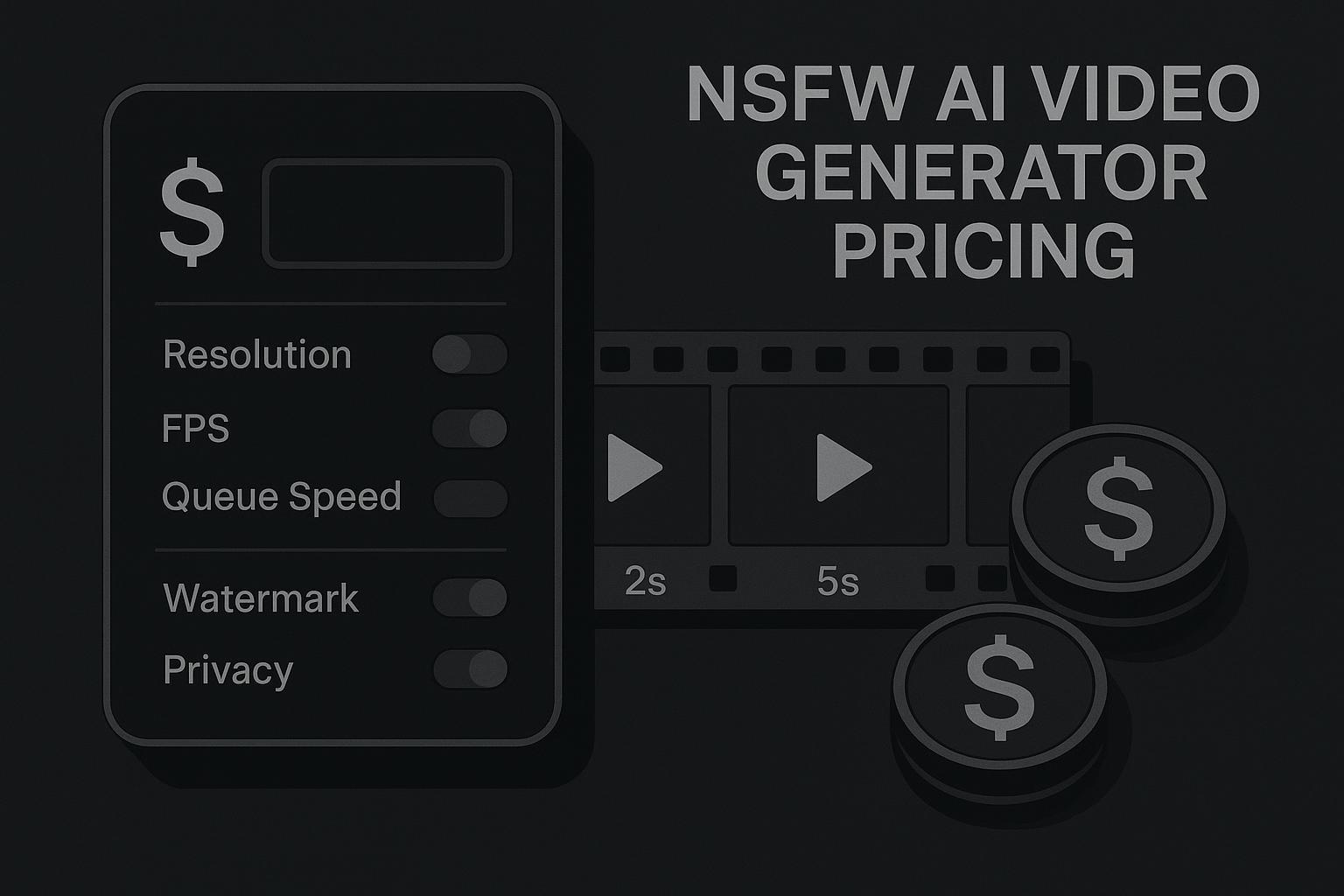
Dimension | What free tiers typically look like | What it means for you |
|---|---|---|
Clip length | Usually single-digit seconds per generation | You can test motion + style, but not full scenes |
Resolution | Often capped below top-tier output | Fine for previewing; less ideal for exporting |
Credits / quota | Daily credits, small trial bundles, or hard daily caps | You can iterate a bit—then you wait |
Queue / priority | Free users wait; paid users skip the line | “Free” can feel slow during peak hours |
Watermark | Varies by tool and plan | You may need paid to publish clean outputs |
Control tools | Fewer settings, fewer consistency controls | Harder to get repeatable results |
Privacy | Often unclear unless the policy is explicit | “Free” may be paid for with data |
1) Clip length: free usually means “short, testable segments”
Even when a site markets “free AI video,” the length options often come in fixed short buckets.
For example, Pixelbin’s AI video generator exposes lengths like 4, 6, or 8 seconds—a good illustration of how the category is engineered for short clips first, because the costs rise quickly as you add frames and resolution (see Pixelbin’s AI video generator length options (4, 6, or 8 seconds)).
In practice, a short free clip is still useful if your goal is to test:
whether the model can keep a character stable for a few seconds
whether the motion looks coherent (hands, anatomy, camera movement)
whether the platform blocks adult prompts at all
What you generally can’t do for free is produce a sequence with continuity—because you’ll hit quota limits long before you get enough iterations.
2) Resolution: free output is often “good enough to evaluate,” not “final export”
Resolution caps vary widely, but the pattern is consistent: free tiers prioritize getting you a result over giving you the best export.
If you only need a “does this look right?” check, lower-res output can be fine.
If you’re aiming to:
crop aggressively,
repurpose for a larger canvas,
or avoid obvious artifacts,
…resolution starts to matter much more, and free tiers stop feeling generous.
3) Credits / quota: free is a taste of iteration, not a workflow
A lot of “free NSFW AI video generator” experiences boil down to a credit system.
The critical thing isn’t the number of free credits—it’s the cost per attempt.
A short clip that costs “just a few credits” can still be expensive if you need 20–40 tries to get acceptable motion consistency.
So when you compare tools, look for:
how many attempts you can realistically run in one sitting
whether unused credits expire
whether retries for failed generations cost the same
4) Queue time: the hidden cost that makes “free” feel broken
In peak hours, queue time is what turns “I’ll just test this” into “I’ll come back later.”
This is also where many readers misinterpret the category:
Slow output isn’t always a bad model.
It’s often a capacity policy: free users wait; paid users are prioritized.
If you’re testing a free tier, treat speed as a plan feature, not a model feature.
5) Watermarks: inconsistent—but you should assume they’re possible
Some platforms watermark free outputs, some don’t, and some change the rule based on the specific mode.
If your intent is private exploration, watermarks might be irrelevant.
If you want to publish, share, or reuse content, assume you’ll need to verify:
whether watermarks exist (visible or not)
whether removal is paywalled
whether the tool requires attribution
6) Control tools: the thing free tiers rarely give you
People fixate on whether a tool is “uncensored.”
But for video, control is often the difference between a fun demo and something usable.
In free tiers, you’ll often see limited access to:
stronger consistency controls
higher-quality modes
more granular generation settings
That’s why two tools can both “allow NSFW,” yet feel completely different in usability.
7) Privacy: if it’s free, you should read the policy like it matters
With adult content, privacy isn’t a “nice to have.” It’s a decision criterion.
Before you upload anything or write anything sensitive, check whether the tool:
stores your prompts or outputs
uses your content for training
explains retention and deletion clearly
If the policy is vague, treat that vagueness as a real product limitation.
If you want the same “free-but-honest” framing for the image side of this category, the sister piece Free AI Porn Limits is a useful reference point for how free tiers tend to work when the output is NSFW.
Why free tiers have these limits (without the fear tactics)
Two forces shape the “free” experience more than anything else: compute cost and policy risk.
Compute cost: video gets expensive fast
Video generation isn’t “an image, but longer.” It’s many frames, plus temporal consistency.
That’s why most services cap length: more frames, higher resolution, and more inference steps all raise cost.
If you want a concrete explanation, Mvix breaks down the mechanics in its explainer on why AI video generators cap clip length.
So when a free tier caps you at short clips, it’s often not malice.
It’s that unlimited free video would invite abuse, overwhelm capacity, and make the product unusable for everyone.
Policy risk: many mainstream tools are SFW by design
If you’ve tried well-known AI video generators and they refuse adult prompts, that’s normal.
Mainstream platforms often restrict sexually explicit content in their usage rules—partly for safety reasons, partly for legal and distribution risk.
For example, Google’s policies explicitly outline categories of prohibited use for generative AI, including sexual-content-related restrictions (see Google’s Generative AI Prohibited Use Policy).
A mainstream roundup like PCMag’s 2026 roundup of AI video generators also reflects this reality: many popular tools either don’t support NSFW at all or treat it as out-of-scope.
That’s why the SERP can feel confusing:
“free AI video generator” results are often SFW-friendly tools.
“free NSFW AI video generator” results often come from niche platforms, aggregators, or credit-based services.
When free isn’t enough (and it’s reasonable to pay)
Here’s the most honest upgrade logic I can give you:
If you only need to confirm “does this category work for me,” free is fine.
But if you need any of the following, free tiers usually stop working:
longer clips (or any workflow that needs multiple generations per scene)
higher resolution outputs you can reuse without obvious artifacts
predictable throughput (less waiting, fewer hard daily caps)
more control to get consistency and reduce retries
If that’s what you’re actually trying to do, you’re not “being tricked into paying.”
You’re moving from “trial” to “workflow.”
At that point, it’s worth looking at a platform that’s built for adult creation rather than treating it as an edge case.
DeepSpicy is an NSFW AI generation platform covering image, video, and uncensored chat.
If you want to see what an adult-focused workflow looks like, start with the DeepSpicy NSFW AI video generator page above.
And if you’re comparing limits (credits, queue priority, and generation settings), you can see DeepSpicy pricing—look specifically at the Content Generation Settings section to understand what changes when you move beyond the free tier.
If you want a deeper “free vs paid” breakdown, you can follow the handoff into DeepSpicy Free vs Paid comparison or the more pricing-specific free vs paid pricing reference.
Quick checklist: how to evaluate any “free” NSFW AI video tool
Before you invest time (or upload anything), use this checklist:
Does it truly allow adult prompts? Many tools are SFW-only by policy.
What’s the clip-length cap per generation? If it’s single-digit seconds, plan accordingly.
How many attempts can you realistically run today? Quota matters more than “free.”
Is there a queue? If yes, does it get worse at peak hours?
Are outputs watermarked? Especially if you plan to share or publish.
What does the privacy policy say about retention and training? Vague language is a red flag.
Are you generating only fictional, consenting adult scenarios? If not, stop.
FAQ
Can a free NSFW AI video generator really be “uncensored”?
Sometimes, but “uncensored” often means “less strict content moderation,” not “anything goes.” Many platforms still block illegal or non-consensual content.
Why do free tools cap clips at a few seconds?
Because cost scales quickly with frames and resolution, and longer clips are harder to keep consistent. For a deeper explanation, see Mvix’s explainer on why AI video generators cap clip length.
Is “free” a good way to test if I should pay later?
Yes—if you treat free as a way to test workflow fit (prompting, style, motion quality), not as a dependable production pipeline.
Are mainstream AI video generators usable for explicit content?
Usually not. Policies and safety constraints mean many mainstream tools refuse explicit prompts. A broad overview is reflected in PCMag’s roundup of AI video generators (2026).
Next steps
If you’re still in “I just want to see if it works” mode, use free tiers to test short clips, learn what settings matter, and get a feel for motion consistency.
If you already know you need longer, cleaner, and more repeatable outputs, start with an adult-focused workflow like DeepSpicy's NSFW AI video generator and then see DeepSpicy pricing to compare generation settings in context.